The import
orders_ingest
Fetches, maps, validates and loads. A contract failure stops the batch before loading and saves a structured incident.
Open-source proof of concept · By César Zea
I built DAG-Healer to explore how AI can help investigate and resolve failures in data pipelines: gather the evidence, propose a repair, and apply it when the required checks pass.
A working example with Apache Airflow, Claude Code and a source API that changes without warning.
An external API changes. An import fails. Someone has to read the logs, compare payloads, work out what changed and decide whether a correction is safe. Repeating that investigation costs engineering time.
DAG-Healer prepares a diagnosis and a proposed fix from the evidence captured at failure. For the limited failures it can verify, it also applies the correction and recovers the pipeline. Everything else is handed to a person with the evidence and an explanation.
The purpose is to explore where this can reduce operational work, and what controls are needed around the model’s judgment.
Broken contract rules, source fields, sample records and the last good run.
Claude Code assesses the failure and whether the replacement field means the same thing.
Code enforces the policy, permitted actions and data checks against a trial import.
Apply a verified mapping and rerun, or refuse the change and explain why.
A retry usually repeats the same failure when the source schema has changed. In this Airflow capture, the mapping was repaired between attempts: try 1 failed, and try 2 succeeded after the mapping had been repaired.
The import and the repair are separate DAGs. The incident queue is their interface; the import does not call or trigger the repair workflow.
The import
orders_ingestFetches, maps, validates and loads. A contract failure stops the batch before loading and saves a structured incident.
The reliability layer
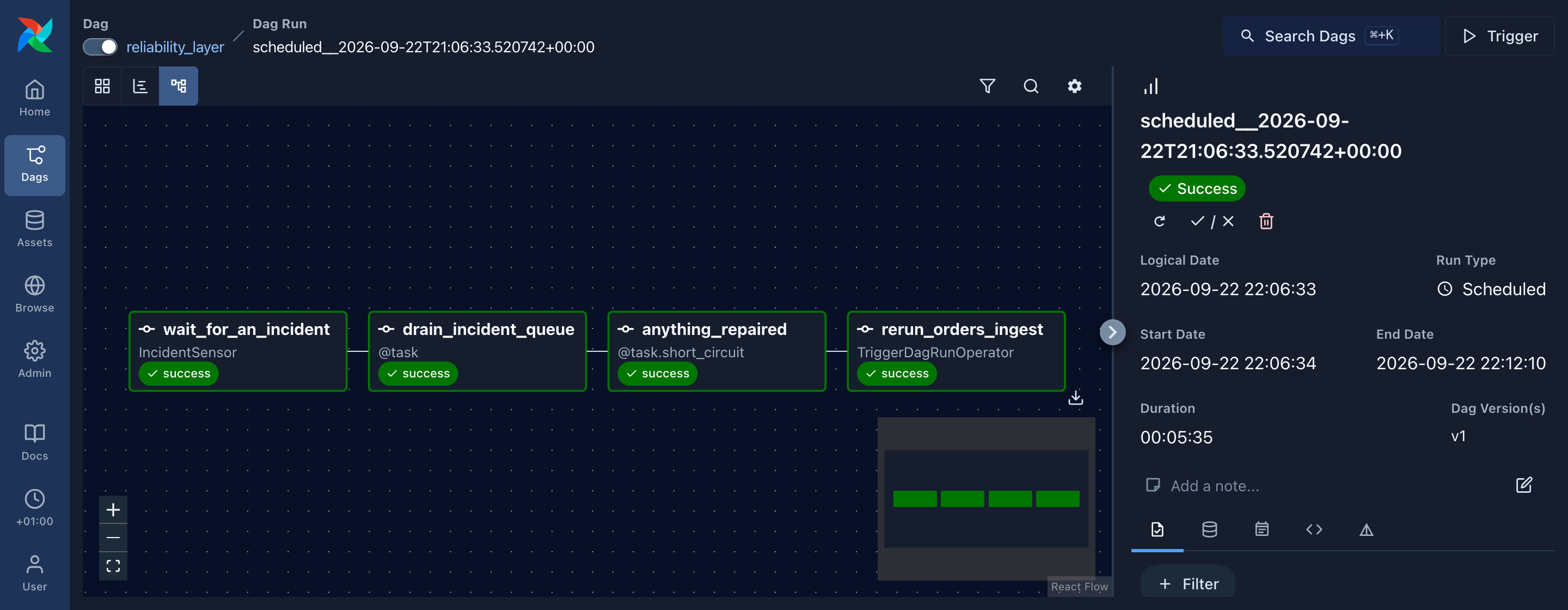
reliability_layerWaits using a deferred sensor, releasing the worker while idle. It drains incidents, diagnoses and checks each proposal, then triggers the import again after a repair.

The step-by-step walkthrough below shows the complete console output from running the demo script, scripts/demo.sh, with this command:
./scripts/demo.sh --no-pauseOpen each phase to follow the script’s explanations and execution traces, or switch to Raw to read its original console output.
A simulated shop API replaces total_price with order_total. The amounts are unchanged. The reporting field, total_amount, must keep its original meaning.
This walkthrough calls the same Python functions used by the DAGs, without an Airflow scheduler. Phase 4 uses a live Claude Code call: Opus 5.5, maximum reasoning effort.
Read the complete execution traceLoading the complete original transcript…
Open original .txt ↗The repair may repoint the source of an existing reporting field. It cannot rewrite application code, add reporting fields or relax the data contract.
These checks run in ordinary Python. Any failed required check stops the repair and produces a record for a person to inspect.
Is this failure class eligible for automatic repair? Is the declared confidence above the configured minimum? In this run, a rename can be repaired and reviewed afterwards; a semantic change must be escalated.
The proposal must use an explicit permitted action: remap_field, retry or escalate. Model confidence cannot authorize another operation.
The reporting field must already exist. The proposed source must occur in the API payload and must not already feed another reporting field.
A complete assessment must identify the proposed fields, include old and new examples, and judge their contents equivalent. This checks the assessment’s completeness; it does not independently prove the model’s judgment.
A trial import must satisfy the contract and the baseline comparison. Here, the replacement remains numeric, its mean must be within 25% of the reference, and its missing-value rate within 5 percentage points.

This Airflow capture is a separate execution from the console walkthrough above. It shows the mapping change and every recorded check in the task log.
The demo deliberately supplies incorrect diagnoses in phases 7 and 8. These are controlled tests of the verification, not mistakes observed in the live model call.
They show why passing a data contract, or looking statistically similar, cannot establish that two fields mean the same thing.
Phase 07 / Wrong delivery-charge mapping
The supplied proposal maps the order total to shipping_price, including a deliberately false equivalence claim. The values satisfy the contract, but the baseline catches the difference.
Refused. The 97% difference exceeds the 25% tolerance. Mapping and loaded data remain unchanged; an escalation report explains the refusal.
Phase 08 / Subtotal on an isolated copy
The fixture substitutes a subtotal worth 90% of the true amount. With a semantic_change diagnosis, policy refuses it. With a false rename classification and false equivalence claim, every implemented check passes.
Accepted by these checks. The 10% difference fits inside the tolerance. Incorrect amounts are loaded into the isolated copy, leaving the recovered pipeline untouched.
Two separate recorded live model checks of the subtotal case classified it as a semantic change and requested escalation. That is an encouraging observation, not an accuracy guarantee. Read the original responses ↗
The repository includes the two DAGs, the fake shop API, policy and contract files, the guided demo, tests and design notes. You can inspect every applied or refused correction.
This is a local proof of concept covering a narrow set of cases. It has not been designed or validated for production pipelines; use the supplied demo data.
Python 3.13, Docker, and Claude Code 2.1.280 or later with access to Opus 5.5.
git clone https://github.com/cesarzea/dag-healer.git
cd dag-healer
make install
./scripts/demo.sh
The demo asks before starting the fake API in Docker and pauses between phases. Add --no-pause to run continuously. Without Docker, start the API with make api in another terminal.
To see the scheduler, task dependencies, incident sensor and logs in the UI:
docker compose up
# Open http://127.0.0.1:8080
The DAGs support Airflow 3.3.2 and 2.11. The automated tests cover the repair controls, refused actions and demo boundaries; passing them does not establish correctness for arbitrary pipelines.
View the test workflow ↗More failure classes with appropriate checks, durable incident delivery, coordination between workers, rolling baselines and a review step before repaired data reaches reporting. The practical questions are how much investigation time this saves, how much review it needs, and how often it accepts or refuses the wrong repair.
Read the design rationale ↗I use working examples like this to discuss where AI can reduce operational effort, what evidence would justify automation, and where human judgment should remain.
By César Pedro Zea Gómez · Based on the README and live demo recorded on 22 September 2026. The screenshots show separate Airflow executions.