User reference / Read the reports
Analyst assessment
Read every field of the summary, blind ranking, vote comparison and process evaluation.
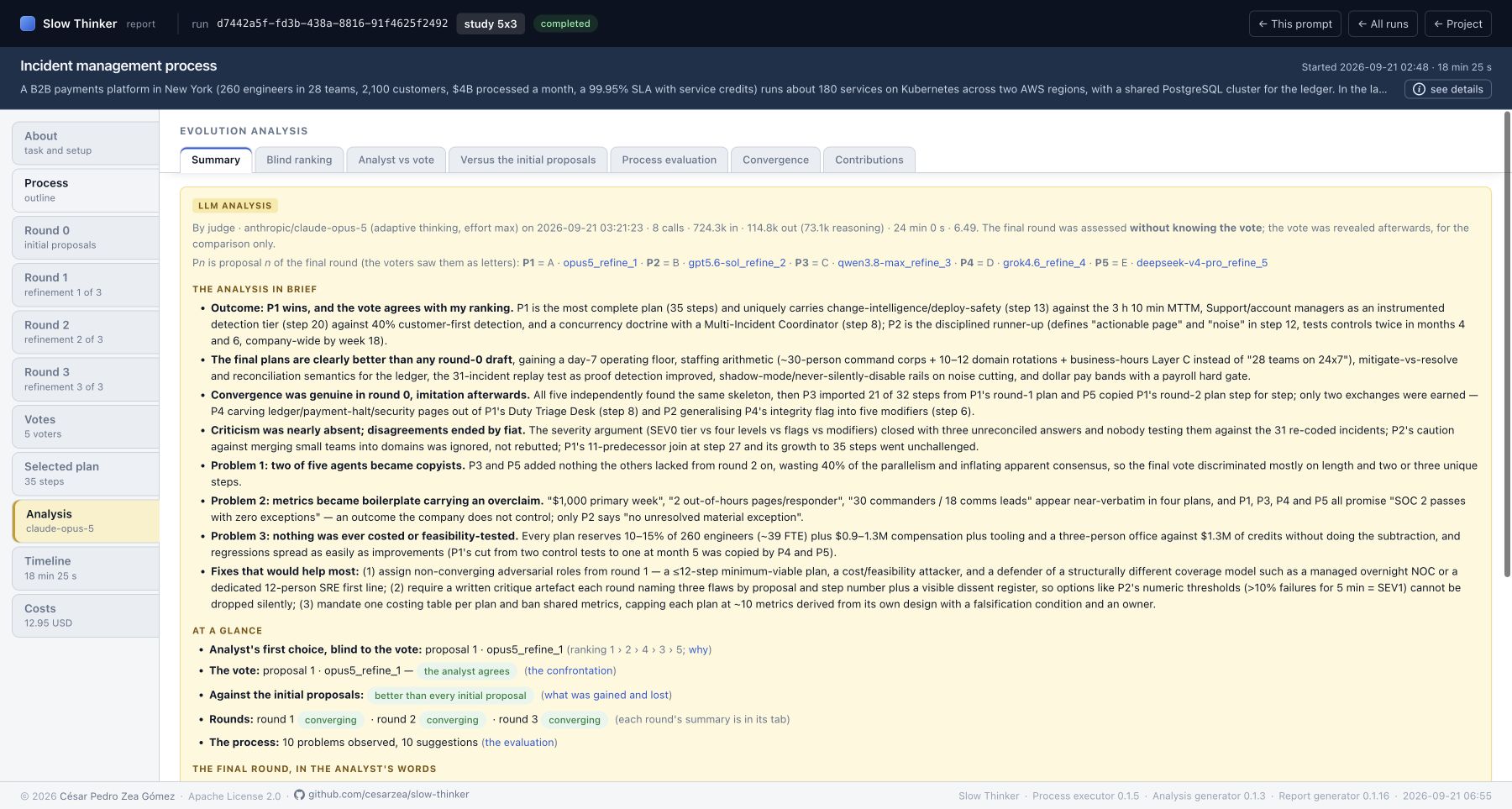
Recorded: executor 0.1.5 · analyst 0.1.3 · report 0.1.16
Captured 2026-09-21 · Capture provenanceExplore this view ↗
The Analysis tab combines an optional LLM assessment with deterministic Convergence and Contributions views. Yellow content is the analyst's interpretation. Opening these tabs does not make calls; the interpretation was saved before the HTML was generated.
| Element | Meaning |
|---|---|
| Analyst identity and settingsReviewed A 0.1.4 · R 0.1.16 | Saved name, provider/model and reasoning/sampling controls used to produce the current assessment. |
| TimestampReviewed A 0.1.4 · R 0.1.16 | When the analysis record was created, not when the original collaboration ran. |
| Calls, input/output/reasoning, model time and costReviewed A 0.1.4 · R 0.1.16 | Aggregate recorded usage for this one assessment. Historical analyses are not added to this page's totals. |
Pn / final-label legendReviewed A 0.1.4 · R 0.1.16 |
Maps analyst slot numbers to final proposals, authors and the report's voting letters. Links open the original cards. |
| BriefReviewed A 0.1.4 · R 0.1.16 | Analyst 0.1.4's final synthesis of its own assessment. The prompt requests at most eight points; validation checks nonempty text, not an exact bullet count. Missing older briefs are explicitly identified. |
| At a glance: blind choice / rankingReviewed A 0.1.4 · R 0.1.16 | The analyst's preferred final proposal and complete order, linked to Blind ranking. |
| At a glance: vote / agreementReviewed A 0.1.4 · R 0.1.16 | The actual selected proposal and the analyst's later agrees/disagrees judgment, linked to Analyst vs vote. |
| At a glance: better than every initial proposalReviewed A 0.1.4 · R 0.1.16 | Analyst's boolean judgment about its first choice against all initial proposals, linked to the detailed comparison. |
| At a glance: roundsReviewed A 0.1.4 · R 0.1.16 | Counts converging/diverging refinement judgments and unavailable analyses. These are analyst labels, not title-distance measurements. |
| At a glance: processReviewed A 0.1.4 · R 0.1.16 | Counts entries in the process-issues and suggestions lists; links to Process evaluation. |
| Final-round summaryReviewed A 0.1.4 · R 0.1.16 | Analyst's narrative of the final alternatives and common ground. |
| Raw prompts and responsesReviewed A 0.1.4 · R 0.1.16 | Expand to inspect the assembled exchanges for the analysis stages. Stage labels identify round, outcome, process, vote comparison and Brief where recorded. |
The captured report is an existing saved assessment. Its recorded provenance is shown in the caption; read Versions before assuming a missing field is a zero or a new field was generated by an old record.
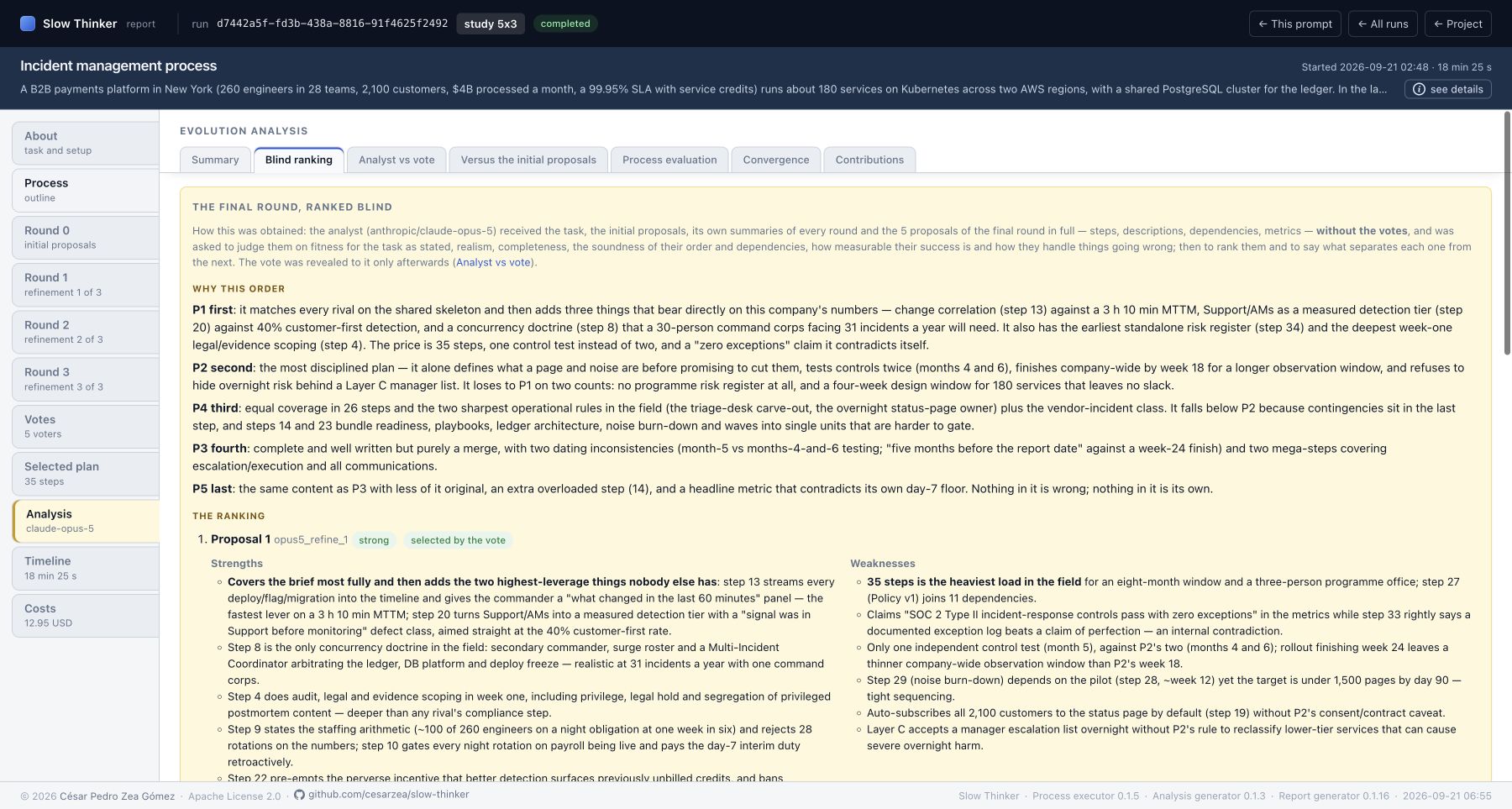
Recorded: executor 0.1.5 · analyst 0.1.3 · report 0.1.16
Captured 2026-09-21 · Capture provenanceExplore this view ↗
| Element | Meaning |
|---|---|
| Method explanationReviewed A 0.1.4 · R 0.1.16 | The analyst assesses the final alternatives before it receives the actual votes. Author/model identities remain present in analysis prompts. |
| Why this orderReviewed A 0.1.4 · R 0.1.16 | Reasons for the complete ordering. It should explain tradeoffs, not merely repeat the winning plan. |
| Ranked proposalReviewed A 0.1.4 · R 0.1.16 | Position, proposal number and linked author. Order comes from the analyst's ranking list. |
| FitnessReviewed A 0.1.4 · R 0.1.16 | strong, adequate or weak: an analyst category for task fitness, not a calibrated probability of correctness. |
| Actual vote winner badgeReviewed A 0.1.4 · R 0.1.16 | Marks the executor-selected proposal within the blind ranking, which can disagree with first place. |
| Strengths / WeaknessesReviewed A 0.1.4 · R 0.1.16 | Specific points from the final assessment. “None identified” means this analyst supplied no entries. |
The prompt asks the analyst to consider task fitness, realism, completeness, dependencies, measurable outcomes and handling of failure. Validation requires the ranking to contain the expected proposal numbers exactly once; it does not establish the factual truth of its reasons.
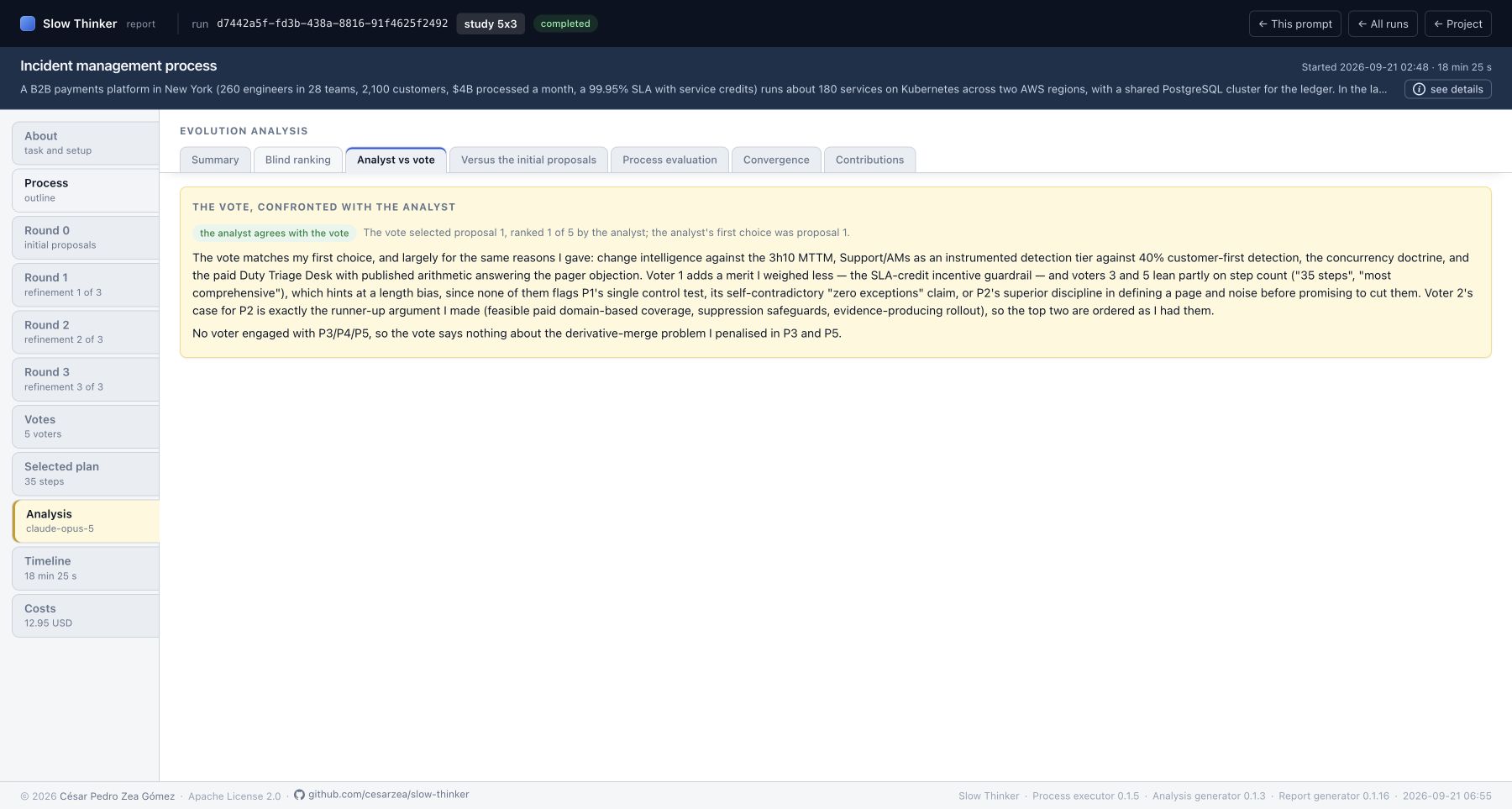
Recorded: executor 0.1.5 · analyst 0.1.3 · report 0.1.16
Captured 2026-09-21 · Capture provenanceExplore this view ↗
| Element | Meaning |
|---|---|
| Agrees / disagreesReviewed A 0.1.4 · R 0.1.16 | The analyst's saved boolean response after seeing the vote and justifications. It is a model judgment. |
| Vote winner and rankReviewed A 0.1.4 · R 0.1.16 | Actual selected proposal and its position in the earlier blind order. |
| Analyst's first choiceReviewed A 0.1.4 · R 0.1.16 | Top proposal in the blind ranking. |
| CommentReviewed A 0.1.4 · R 0.1.16 | Why the analyst accepts or challenges the voting outcome. This later explanation does not revise the saved ranking or plan. |
The stage separates an initial assessment from a reaction to the group's choice. It does not remove all evaluation bias: one model supplies both judgments and has been shown the title-matching hints in earlier analysis stages.
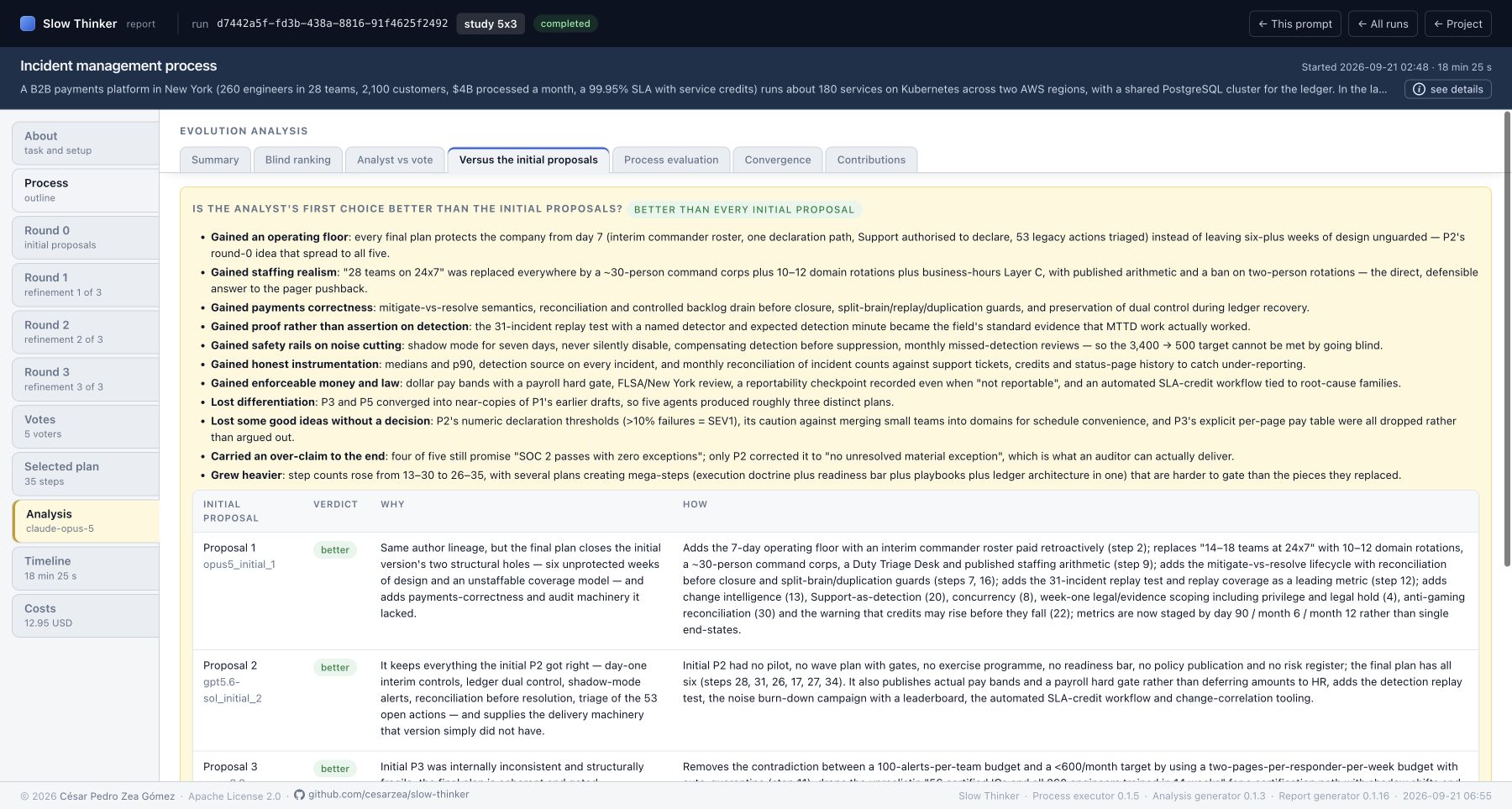
Recorded: executor 0.1.5 · analyst 0.1.3 · report 0.1.16
Captured 2026-09-21 · Capture provenanceExplore this view ↗
| Element | Meaning |
|---|---|
| Better than every initial proposalReviewed A 0.1.4 · R 0.1.16 | improved_over_initial, an analyst judgment about its own first choice in modern blind analyses. It is not necessarily about the voting winner. |
| Improvement summaryReviewed A 0.1.4 · R 0.1.16 | Overall account of gains or losses relative to the starting alternatives. |
| Initial proposal / agentReviewed A 0.1.4 · R 0.1.16 | Which round-0 proposal is being compared. |
| VerdictReviewed A 0.1.4 · R 0.1.16 | better, worse or similar: how the analyst's chosen final proposal compares with that initial proposal. |
| WhyReviewed A 0.1.4 · R 0.1.16 | Reason for that comparison. |
| HowReviewed A 0.1.4 · R 0.1.16 | Specific changes or differences supporting it. |
In legacy schema-2/3 analyses, this comparison concerns the selected plan and the analyst knew the winner. The report's legacy wording differs accordingly.
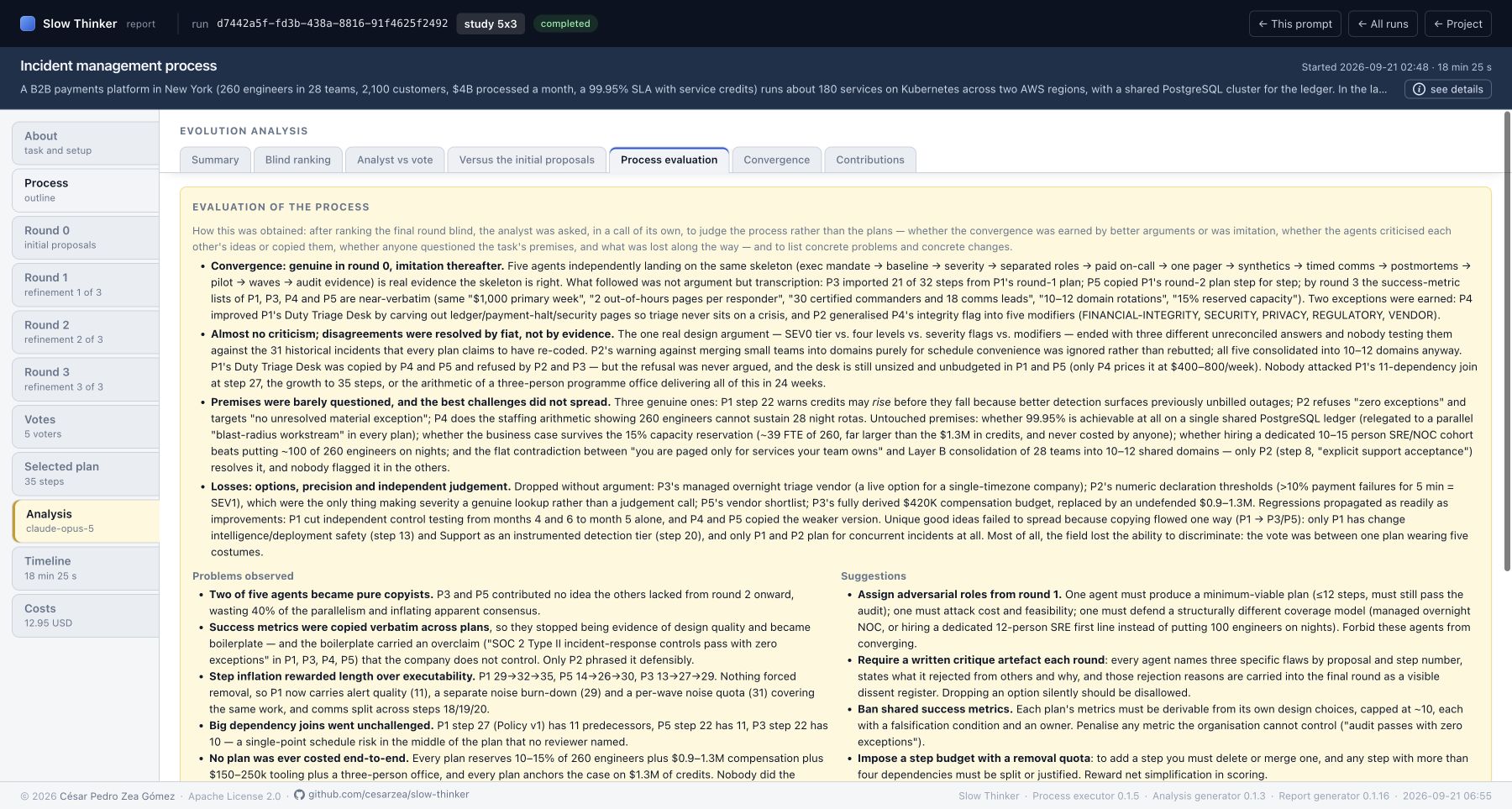
Recorded: executor 0.1.5 · analyst 0.1.3 · report 0.1.16
Captured 2026-09-21 · Capture provenanceExplore this view ↗
| Element | Meaning |
|---|---|
| Process evaluationReviewed A 0.1.4 · R 0.1.16 | Analyst's assessment of how the collaboration worked, separate from whether one final proposal looks good. |
| IssuesReviewed A 0.1.4 · R 0.1.16 | Identified problems such as premature convergence, unexamined assumptions, disappearing objections or weak voting criteria. The contents depend on the experiment. |
| SuggestionsReviewed A 0.1.4 · R 0.1.16 | Proposed changes to prompts, evaluation criteria, participant roles or the collaboration architecture. They are recommendations, not changes already applied by the tool. |
| Empty evaluation noticeReviewed A 0.1.4 · R 0.1.16 | An older assessment omitted the evaluation. The report asks for a fresh analysis rather than interpreting empty text as “no issues”. |
From analyst 0.1.3, process evaluation has its own call and must not be empty. The current pipeline makes this call before revealing the vote. Experiments and independent checks are still needed to establish whether suggested process changes help.
| State or legacy element | What to do with it |
|---|---|
| Not generated / Not analysed yetReviewed A 0.1.4 · R 0.1.16 | The trace exists without an LLM assessment. Recorded proposals, votes and computed metrics remain useful. |
| Outdated analysisReviewed A 0.1.4 · R 0.1.16 | The stored content schema is unsupported by this renderer. Request a new analysis explicitly; HTML regeneration alone cannot upgrade it. |
| Schema 2Reviewed A 0.1.4 · R 0.1.16 | Older final assessment and initial comparisons; no structured taken/rejected influence evidence. |
| Schema 3Reviewed A 0.1.4 · R 0.1.16 | Adds structured influence lists, but the final assessment is still aware of the winner. |
| Legacy Why it wonReviewed A 0.1.4 · R 0.1.16 | An explanation of the selected plan, written with knowledge of selection. Do not treat it as a blind ranking. |
| Legacy strengths / weaknesses / process verdictReviewed A 0.1.4 · R 0.1.16 | Older narrative fields rendered when present, with different evaluation context from the current pipeline. |
| Schema 4Reviewed A 0.1.4 · R 0.1.16 | Blind final ranking and vote comparison, without schema-5 round lists. |
| Schema 5Reviewed A 0.1.4 · R 0.1.16 | Adds shared/differences/influence lists. The component version and actual fields distinguish later additions such as the Brief. |
See the analysis pipeline and schema for exact field names and validation boundaries.
Source files used for this reference
Reviewed at 7361ea0b71a5.