User reference / Read the reports
Timeline & costs
Separate elapsed time, model time, collaboration cost and optional analysis cost.
Recorded: executor 0.1.5 · analyst 0.1.3 · report 0.1.16
Captured 2026-09-21 · Capture provenanceExplore this view ↗
| Element | Meaning |
|---|---|
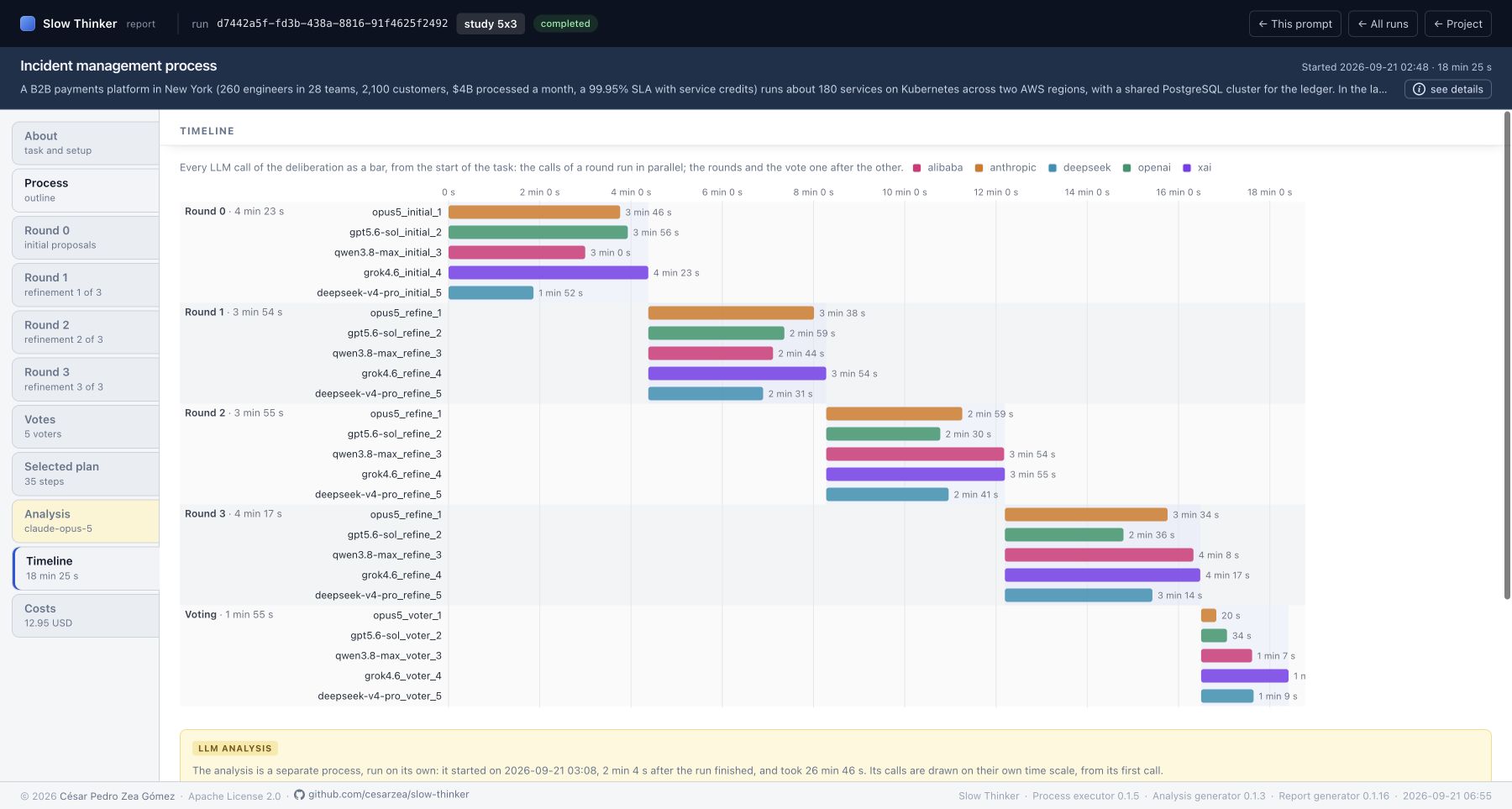
| One row / bar per callReviewed R 0.1.16 | A stored proposal or valid vote call, placed relative to task creation. Horizontal start/end positions show when it ran; width represents duration. |
| Round and Voting bandsReviewed R 0.1.16 | Group calls by execution phase. The shaded span covers the earliest start to latest finish of the group's recorded calls. |
| Provider colours / legendReviewed R 0.1.16 | Identify provider families. These colours are distinct from per-agent colours used in contribution charts. |
| Time axisReviewed R 0.1.16 | Elapsed time from task start, with generated ticks. It is not the sum of call durations. |
| Label beside each barReviewed R 0.1.16 | Formatted call duration. Very short calls can be drawn with a minimum visible width. |
| Call popoverReviewed R 0.1.16 | Agent/call label, model/settings, start and end offsets, duration and token figures when recorded. |
| Reconstructed noticeReviewed R 0.1.16 | Some calls lack exact timestamps; older bars are positioned from recorded durations, assuming calls within a round are parallel and rounds/voting are sequential. |
| No calls recordedReviewed R 0.1.16 | No usable call rows to display. A partial or historical trace may lack accounting. |
The yellow analysis timeline is separate because evaluation can be requested long after execution. Its annotation gives the analysis start, gap after the run and elapsed analysis span. Its zero point is the first analysis call, not the task's start.
| Element | Meaning |
|---|---|
| Round-analysis barsReviewed R 0.1.16 | Parallel analysis calls, one for each recorded round. |
| Final/outcome, process, vote comparison, Brief barsReviewed R 0.1.16 | Subsequent calls present in that particular saved assessment. Newer and older analyst versions can have different call sets. |
| Analysis scaleReviewed R 0.1.16 | Elapsed time from its own first call; compare the numeric axis rather than visual width with the collaboration chart. |
| Reconstructed analysisReviewed R 0.1.16 | If timestamps are missing, round calls begin together, later calls are placed sequentially, and start time is inferred backwards from record creation. |
Timezone-aware timestamps were added in executor 0.1.5. Old naive timestamps are interpreted using the rendering machine's local timezone in the timeline/pricing helpers; they can be ambiguous. See versions.
Recorded: executor 0.1.5 · analyst 0.1.3 · report 0.1.16
Captured 2026-09-21 · Capture provenanceExplore this view ↗
| Element | Meaning |
|---|---|
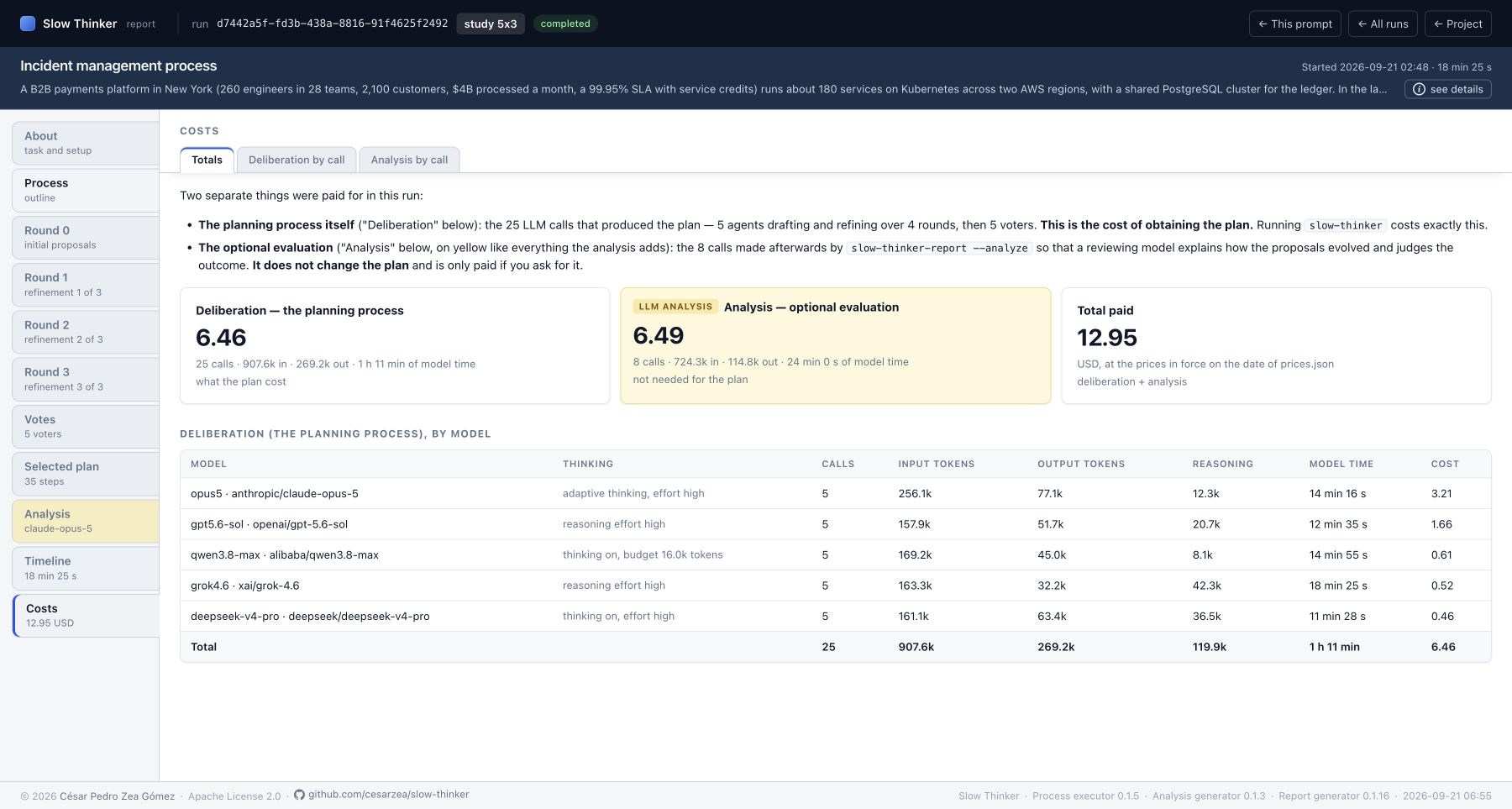
| Deliberation — the planning processReviewed R 0.1.16 | Estimated cost of saved proposal and vote calls. The card also shows call count, input/output tokens and summed model time. |
| Analysis — optional evaluationReviewed R 0.1.16 | Cost and usage of the assessment displayed on this page, not every historical analysis. It did not change the selected plan. |
| Total paidReviewed R 0.1.16 | Renderer label for deliberation plus the displayed analysis estimate. Treat it as recorded-call accounting, not a reconciled provider invoice. |
| Missing-price noticeReviewed R 0.1.16 | At least one model lacks a price. Individual values and affected totals become unknown/dashes rather than silently summing only known prices. |
| By-model table: ModelReviewed R 0.1.16 | Grouped by provider/model. Different reasoning settings for the same model are aggregated here; the displayed settings label is not a separate accounting bucket. |
| ThinkingReviewed R 0.1.16 | Effective recorded settings shown for that model. Use individual call/proposal records when the same model had multiple configurations. |
| CallsReviewed R 0.1.16 | Number of recorded calls included in the aggregate. Invalid/skipped attempts are not comprehensively represented. |
| Input / output tokensReviewed R 0.1.16 | Provider-reported counts added over the included calls. |
| ReasoningReviewed R 0.1.16 | The stored reasoning detail. The pricing code assumes it is included in output and does not add it separately; the renderer does not validate that provider counts reconcile. |
| Model timeReviewed R 0.1.16 | Sum of call durations. Concurrent calls make this larger than elapsed time. |
| CostReviewed R 0.1.16 | USD estimate from the render-time price list and provider rules. |
| Total rowReviewed R 0.1.16 | Corresponding aggregate across models. |
| Field | Meaning |
|---|---|
| Deliberation by call: PhaseReviewed R 0.1.16 | Round number or Voting. |
| CallReviewed R 0.1.16 | Proposing or voting agent ID. The Analysis by call table instead labels the saved analysis stage. |
| Model / settingsReviewed R 0.1.16 | Identity and effective controls of the call. |
| Input / Output / ReasoningReviewed R 0.1.16 | Saved usage counts for that call, subject to provider reporting. |
| TimeReviewed R 0.1.16 | Recorded duration in seconds/minutes, including wrapper time around retries if a later attempt succeeds. |
| CostReviewed R 0.1.16 | Per-call estimate, or a dash when the required pricing/accounting is absent. |
| Analysis totalReviewed R 0.1.16 | Sum of the selected analysis's stage calls. “No analysis has been generated” appears when there is no call list to show. |
| Claude reasoning footnoteReviewed R 0.1.16 | A static note says adaptive thinking is not separately reported. This is explanatory copy, not a check of the current record: the illustrated run actually contains nonzero Claude reasoning counts. Read the stored usage for the particular call. |
A reasoning value of zero can mean the provider supplied no separate detail. Some saved records also contain reasoning counts larger than their output counts; the report displays those fields as recorded and its pricing formula still uses output_tokens alone. It does not reconcile provider-specific usage semantics. Counts are abbreviated (1.2k, 1.23M); monetary figures use three decimals below $0.10 and two otherwise. Rounded displayed rows need not add exactly to a displayed rounded total.
The generic calculation separates ordinary input, cache reads and cache writes, then adds output, all at rates per million tokens. Provider-specific rules can select a prompt-size tier or time-dependent rate. The exact formula and price lookup are in Pricing methods.
The tool uses provider-reported usage, not invoice retrieval. A failed proposal/vote is skipped, a failed analysis saves no partial assessment, and individual retry attempts are not separate billed records. These costs may therefore omit unsuccessful but chargeable work. Legacy records with missing usage also cannot support a complete cost claim. The report's “Total paid” wording should be read with these limits.
Changing prices.json and regenerating HTML can change estimates for the same execution. Keep the price-list revision with an exported experiment when reproducible accounting matters.
Source files used for this reference
Reviewed at 7361ea0b71a5.