User reference / Read the reports
Contributions & efficiency
Trace estimated origins across rounds and interpret every contribution and efficiency measure.
Recorded: executor 0.1.5 · analyst 0.1.3 · report 0.1.16
Captured 2026-09-21 · Capture provenanceExplore this view ↗
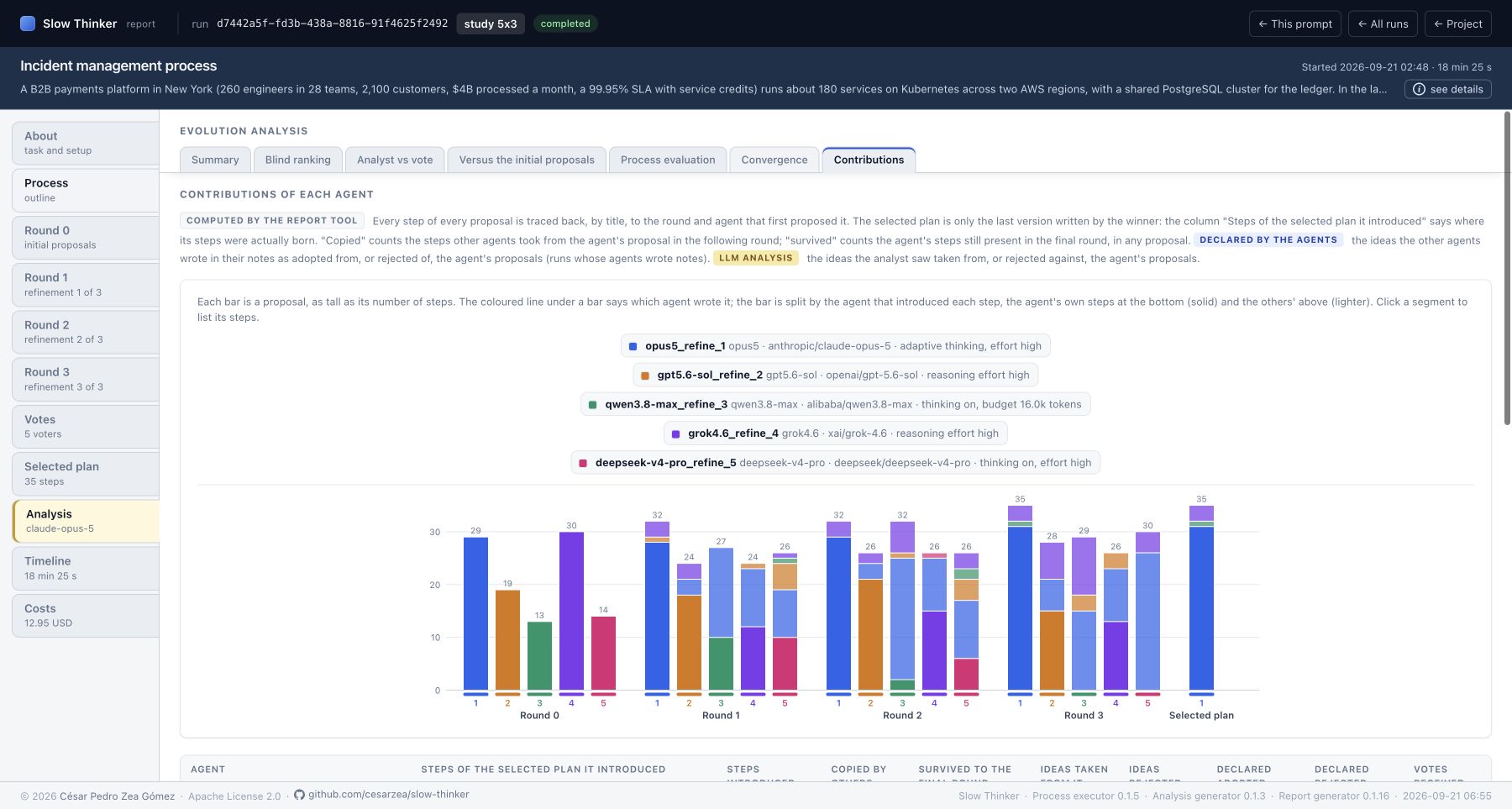
Each current step inherits the earliest source found by repeatedly following title-attributed origins through preceding rounds. “Introduced by” means first found in this run by the heuristic, not proof of authorship, semantic originality or causal influence.
| Chart element | Meaning |
|---|---|
| Round groupsReviewed E 0.1.5 · A 0.1.4 · R 0.1.16 | One group per recorded proposal round, followed by Selected plan when available. The last group repeats the winning proposal; it is not an extra round. |
| One bar per proposalReviewed E 0.1.5 · A 0.1.4 · R 0.1.16 | Height is the number of steps in that proposal. The total is printed above it. |
| Colour below the bar / agent numberReviewed E 0.1.5 · A 0.1.4 · R 0.1.16 | Identifies who wrote that proposal. |
| Solid bottom segmentReviewed E 0.1.5 · A 0.1.4 · R 0.1.16 | Steps traced to introductions by the proposal's own author slot. |
| Lighter segments aboveReviewed E 0.1.5 · A 0.1.4 · R 0.1.16 | Steps traced to introductions by other agent slots, coloured according to the legend. |
| LegendReviewed E 0.1.5 · A 0.1.4 · R 0.1.16 | Agent identities, provider/model labels and settings. Colours identify participants, not performance. |
| Segment popoverReviewed E 0.1.5 · A 0.1.4 · R 0.1.16 | Number of attributed steps out of the proposal total, their step numbers/titles and introducing agent. Click to keep it open. |
| Horizontal panReviewed E 0.1.5 · A 0.1.4 · R 0.1.16 | Drag or scroll horizontally when many agents/rounds exceed the available width. |
A proposal authored by one model can contain many steps attributed to others. Conversely, the same conceptual idea may be counted as several new introductions after title changes.
| Column | Exact count and limits |
|---|---|
| AgentReviewed E 0.1.5 · A 0.1.4 · R 0.1.16 | Agent slot shown with its latest recorded proposal ID/model/settings. A badge marks the slot that authored the selected final proposal. |
| Steps of the selected plan it introducedReviewed E 0.1.5 · A 0.1.4 · R 0.1.16 | Number of current selected-plan steps whose traced origin belongs to this agent. The “of N” denominator is plan size; listed step numbers locate them. This counts plan positions, not distinct source ideas. |
| Steps introducedReviewed E 0.1.5 · A 0.1.4 · R 0.1.16 | Number of step coordinates that are their own origin: all round-0 steps plus later steps with no qualifying preceding source. Coordinates are (round, agent slot, step number). |
| Copied by othersReviewed E 0.1.5 · A 0.1.4 · R 0.1.16 | Count of current steps assigned to this agent's preceding proposal in cross-agent transitions, across all refinements. It credits the immediate source, even if that source originally borrowed the step. Multiple recipients and rounds can count the same lineage repeatedly. |
| Survived to the final roundReviewed E 0.1.5 · A 0.1.4 · R 0.1.16 | Number of distinct original step coordinates introduced by this agent that remain in any final proposal. Copies across several final proposals count once. It is not restricted to the winner. |
| Ideas taken from itReviewed E 0.1.5 · A 0.1.4 · R 0.1.16 | Number of analyst taken list entries naming this source agent across analysed refinements. These are idea-list occurrences, not deduplicated concepts or matched steps. |
| Ideas rejectedReviewed E 0.1.5 · A 0.1.4 · R 0.1.16 | Same aggregation for analyst rejected entries. It is not a negative quality score for the source agent. |
| Declared adoptedReviewed E 0.1.5 · A 0.1.4 · R 0.1.16 | Number of adopted idea-list entries in legacy notes received from other proposals. A dash means the run lacks these declarations. |
| Declared rejectedReviewed E 0.1.5 · A 0.1.4 · R 0.1.16 | Same for rejected entries in legacy notes. Absence of notes is not zero observed rejection. |
| Votes receivedReviewed E 0.1.5 · A 0.1.4 · R 0.1.16 | Saved valid votes for the agent's final-round proposal. Earlier contributions do not themselves receive votes. |
Rows are sorted by selected-plan contribution descending, then copied count descending, then agent number. Table ordering is not an overall model ranking. One source step can be reused by multiple current steps, so selected-plan counts can differ from the number of distinct surviving introductions.
Recorded: executor 0.1.5 · analyst 0.1.3 · report 0.1.16
Captured 2026-09-21 · Capture provenanceExplore this view ↗
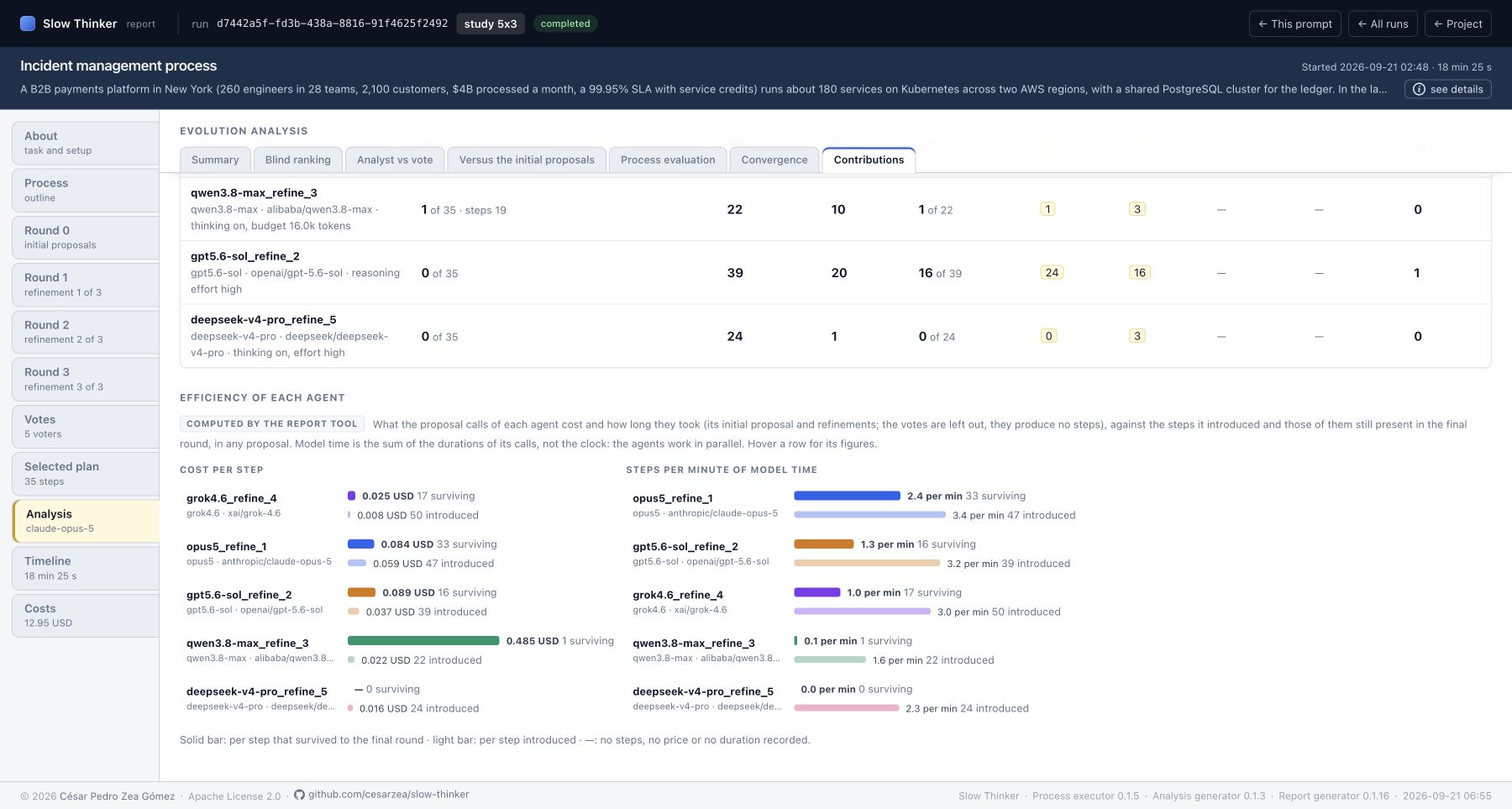
The efficiency charts use proposal calls only, initial plus refinements. Voting and post-run analysis are excluded because they do not produce proposal steps. Model time is the sum of those call durations.
| Element | Calculation and reading |
|---|---|
| Cost per surviving step, solid barReviewed E 0.1.5 · A 0.1.4 · R 0.1.16 | Agent's recorded proposal-call cost divided by its number of distinct introduced steps surviving anywhere in the final round. Lower is cheaper on this proxy. |
| Cost per introduced step, light barReviewed E 0.1.5 · A 0.1.4 · R 0.1.16 | The same cost divided by every introduction attributed to that agent. |
| Surviving steps per minute, solid barReviewed E 0.1.5 · A 0.1.4 · R 0.1.16 | Distinct surviving introductions divided by summed proposal-call seconds / 60. Higher is more output on this proxy. |
| Introduced steps per minute, light barReviewed E 0.1.5 · A 0.1.4 · R 0.1.16 | All attributed introductions divided by summed proposal-call minutes. |
| Bar lengthReviewed E 0.1.5 · A 0.1.4 · R 0.1.16 | Relative scale within that chart; cost and time charts have separate scales. Cost rows sort cheapest surviving step first; time rows sort highest surviving throughput first. |
| Value / small step labelReviewed E 0.1.5 · A 0.1.4 · R 0.1.16 | Rounded ratio plus denominator/context (“surviving” or “introduced”). |
| Row popoverReviewed E 0.1.5 · A 0.1.4 · R 0.1.16 | Agent/model/settings, proposal-call count, total recorded proposal cost, summed time, introduced and surviving counts. |
| Dash / absent chartReviewed E 0.1.5 · A 0.1.4 · R 0.1.16 | A required price, nonzero step denominator or duration is unavailable. If no agent has usable values for an entire measure, its chart is omitted. |
These measures describe expenditure per title-attributed step, not expenditure per correct idea. A model can produce many small steps or preserve weak material. Compare the underlying proposals before using an efficiency ratio as a client-facing benefit claim.
Source files used for this reference
Reviewed at 7361ea0b71a5.